
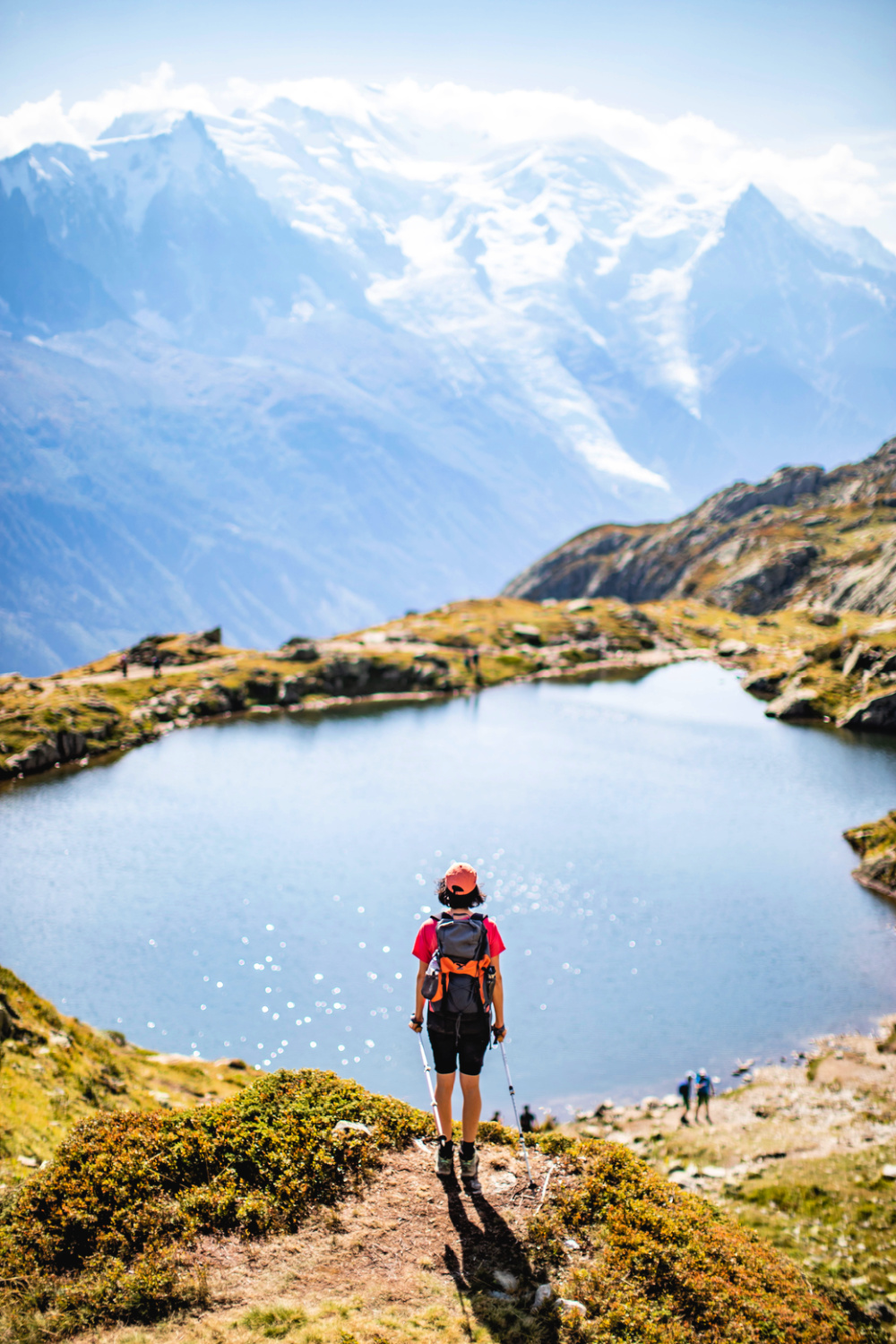
GOING FOR walks — even short, around-the-block kind of walks, has been my quality-of-life saver since my teenage years.
Back then, and sometimes at my mom’s suggestion, we’d head out together in the evenings, traipsing without a plan around the streets of our local neighbourhoods.
It was our “nightcap”. Putting to rest events of the day and returning home refreshed and unburdened, connected by conversation and sometimes by silence.
Just the two of us, arm in arm, ‘shooting the breeze’, as she’d like to say. Those are precious footprints frozen in time, enriched by the memory of autumn leaves crunching underfoot, snowflakes illuminated under lampposts, and a bracing chill or balmy breeze on our faces.
In time, walks for pleasure became less frequent as life became busier, but about 12 years ago, when work got the better of me and various aches and pains precluded jogging or the gym, my sister suggested taking long walks again.

As luck has it, I live in a suburb of Geneva where farmland, fields, vineyards and forests sit not too far from my front door.
I enjoyed discovering well worn paths but always marvelled at how a previously unnoticed side-path or opening in the forest could introduce a whole new panorama such as a nature conservation area or an open pasture where horses grazed.
The more hiking I did, the more I wanted to do.
I rejoined the American International Women’s Club specifically for its hiking group and eventually, with the SwitzerlandMobility app in hand, I learned new trails in Canton Vaud that I began to share by leading hikes for my fellow members.
I felt real satisfaction challenging myself to learn new trails and to piece together strands of intersecting ones to devise a satisfying whole that included a bit of this and a bit of that: forest, lake or alpine panorama, medieval village, architectural landmark, café, or hot chocolate emporium. Readily available local transport made getting to and fro relatively easy and affordable.
The physical and mental benefits added up: weight loss, muscle and stamina building, less stress, more mental clarity, greater self confidence; meeting people (and their pets); getting close to nature and wildlife, and the pleasure that comes from sharing the experience with friends.
I learned my limits as well, stretching myself to go further and pick up my pace while also respecting my fitness in general and on the day. I’m no long distance hiker, nor can I scale heights that others may, but I’m perfectly happy with easy-to-medium trails and congratulate myself if I’m able to do a little bit more than I’ve done before without injuring or exhausting myself.
With that in mind, hiking never fails to reveal new opportunities for discovery that I wouldn’t realise without curiosity, perseverance, a bit of pluck and an invaluable little iPhone app.
Please note: the following section has been updated (September 2023) to reflect recent updates to the SwitzerlandMobility webpage.
SwitzerlandMobility – your ticket to a whole new world

Let me introduce you to my go-to hiking buddy. No need to strap on your hiking boots just yet, we’ll be doing some armchair exploring first.
While the SwitzerlandMobility app is great for using on the go, first check out the recently updated internet version with its larger format that makes for easier viewing and also for cross-checking, for example, with Google maps, when you want even more local detail.
To get you going, let’s explore some of the site’s main features.
On the SwitzerlandMobility homepage select Hiking in Switzerland, from where you can access seven National Routes; nine Regional Routes; hundreds of Local Routes and over 80 Obstacle/Barrier-Free Routes for people with disabilities or with baby carriages.
Let’s say you’d like to learn more about the 33 stages of National Route 4, the Via Jacobi (St. James Way/Camino de Santiago) that in Switzerland runs from Rohrschach near St. Gallen in Switzerland’s northeast corner to Geneva in its southwest.
Just click on National Routes and then on the text box for “Via Jacobi” (or “to the route”). You’ll find an overview of the entire route’s length, levels of difficulty, elevation changes, a description and photographs of architectural, natural and cultural highlights along the way.

Scroll your cursor up to the top of the page to see a map of the entire Via Jacobi route indicated with red dots. Click on any of the dots to see the different hiking routes that intersect in that one spot on the trail.
In the lower right corner of the map, you’ll find two icons: click on the lower, map-shaped icon to enlarge or minimize the map (+ or -), for a GPS locator, and a print/email/share-to-social media icon.

Click on the upper, three-stacked-squares icon to select additional map contents: I recommend activating Route Numbers, Photos (small black boxes appear along the route to click on for snapshots of local identifiers, helping you stay on track), Closure/Diversion, to alert you to current changes to your planned route, PublicTransport (for essential train and bus info); and Map in Colour for easier viewing.
Back on the main page below the map, check out the menu items from which you can choose to learn more about the hike’s various Stages; Arriving at/getting around each stage via public transport; Travel reports (in German only); Bookable trips (hiking tours); Accommodation along the way; Places (major cities and towns) and Places of special interest (for example, St. Gallen’s Textile Museum).
Focus on the Via Jacobi – Rolle to Coppet
Now let’s get even more specific. Click on Stages and select Stage 18: Rolle to Coppet. You’ll see photographs, a descriptive overview, elevation variations, hike distance and approximate duration, and level of difficulty (click on the (i) next to the word “easy” or “difficult” for SwitzerlandMobility’s definition of easy, medium and difficult trails).

Scroll up for the map at the top of the page where Stage 18 is indicated with red dots. Using the same two map icons in the bottom right corner, enlarge or minimize the map (or use your mouse to scroll in or out), email/print/and share the map and adjust the map contents to suit your preferences.
If you’ve selected Public Transport in the legend, you’ll be able to click on a train, bus or boat icon to find the name of the closest or most convenient transport stops to get to and from your chosen route. Plug that name into the SBB/CFF/FFS app and your journey falls into place.
Find a trail by search bar
Say you want to hike in one particular area. Simply enter the name of a location in the Search bar in the top menu and you’ll be offered a selection of trails available in that region.
Choose to do as much or as little of the trail as you please, transfer to an adjacent trail, or vary the route according to your whims (perhaps to accommodate ending up at your favourite café).
Wherever you choose to explore, familiarize yourself first with SwitzerlandMobility’s map legend and trail signalization so you’ll be symbol and sign savvy.

Hiking on the go with the SwitzerlandMobility app
Now let’s take a quick look at the smartphone app, which functions in much the same way as the online version. If you haven’t yet done so, download the free app now.
When the main page appears, click on the upper, three-stacked-squares icon and select Summer hikes (or Winter in the Winter months, though I tend to stay with Summer throughout the year), then Hiking in Switzerland. Scroll down and select whichever map features you want, for example, Route Numbers, Closures and Detours, Photos, and Public Transport).
With the middle, Search icon, enter the name of any Swiss city, town or area – the names of your most recent searches come up first.
The bottom, GPS arrow icon, will prove helpful if not essential when you’re trying out the twists and turns of a route for the first time, but you’ll need good connectivity to benefit from it. And carry a battery charger to make sure you have enough ‘juice’ to go the distance.
Activate the GPS icon: a little red circle with a pointed tip will appear indicating exactly where you are on the map – the tip shows in which direction you’re walking.
Sometimes the tracker sticks, so I just leave the app, reenter and reactivate it, but by and large it’s very dependable and incredibly helpful.
To access a legend with the meaning of every map marking, select the app’s logo (a white ‘star’ on a red square) in the upper left corner and choose “Legend” from the pop-up menu.
SwitzerlandMobility Plus – extra features for a reasonable price
For 35 Swiss francs a year, SwitzerlandMobility Plus gives users access to exclusive functions to help plan your own tours on the web map and share them to the smartphone app so you can use them along the way.
These “swisstopo” maps can be accessed even without network reception.
It’s gratifying to know that the fee supports the work of SwitzerlandMobility to maintain its incredible network of trails that bring so many benefits – of mind, spirit and body – to so many.

Tips for safe hiking
- Before leaving for a hike, consult the weather forecast and don’t take unnecessary chances – postpone or be adequately prepared
- Bring water and food to stay well-hydrated and keep energy levels up
- Carry insect spray and any medication you may need
- Be honest with yourself about your fitness level and consult a doctor beforehand, if necessary
- Dress and equip yourself well, particularly with non-skid, stable hiking shoes or boots; no-blister socks; walking poles for stability and less stress on your back and joints; a warm, rain-proof jacket; a sunhat; suncream and a cell phone charger (lots of photos to take!). And, of course, a comfortable multi-tasking backpack to store your essentials and extras
- Don’t put yourself in danger, be realistic about your level of hiking competence and stay on paths that are safe and you can comfortably handle.
- Start with a simple trail and work up from there. Enjoy yourself!
Helpful links:
- The History Trail of Baron Guigier
- Swiss Heritage’s collection of “historic trails” hiking booklets (F/D/I)
- Top twenty hiking trails in Canton Vaud
I’d love to hear your tips for hiking trails and apps: please share them in the Comments box below this post. Thanks and happy hiking.
Main photo credit: Ben o’bro on Unsplash.
 Creative Living Geneva
3 responses to “Hiking for body, mind and spirit with the SwitzerlandMobility app”
Hint / tip for regular and more adventurous walkers: sign up with Rega, the Swiss Helicopter rescue organisation. They’re there in emergency cases and fly you to the nearest hospital.
Hopefully you’ll never need their help, but still a few $$$s well spent. Happy walking!
LikeLike
That’s a brilliant idea! So glad you suggested it, thanks! The Rega emergency number for inside Switzerland is 1414 and the emergency number abroad is +41 333 333 333.
LikeLike
[…] This post was originally published in its entirety on Creative Living Geneva. […]
LikeLike